
On-Page SEO for Therapists: The Complete Guide
In today’s digital world, most people searching for mental health support start their journey online. If you’re a therapist, your website is often the first impression potential clients get about your practice. However, even the most skilled therapists remain invisible if their site doesn’t appear in search results. On-page SEO is the key to bridging this gap. It helps Google and other search engines understand your expertise, your services, and your value to clients in need.
This guide explains on-page SEO for therapists in simple terms. You’ll learn not just what to do, but why it matters, and how to avoid common mistakes. We’ll cover essential strategies, give you practical examples, and include visual aids to make everything easy to follow.
Whether you run a solo practice or a counseling center, this article will help you reach more clients and grow your impact.
What Is On-page Seo And Why Does It Matter For Therapists?
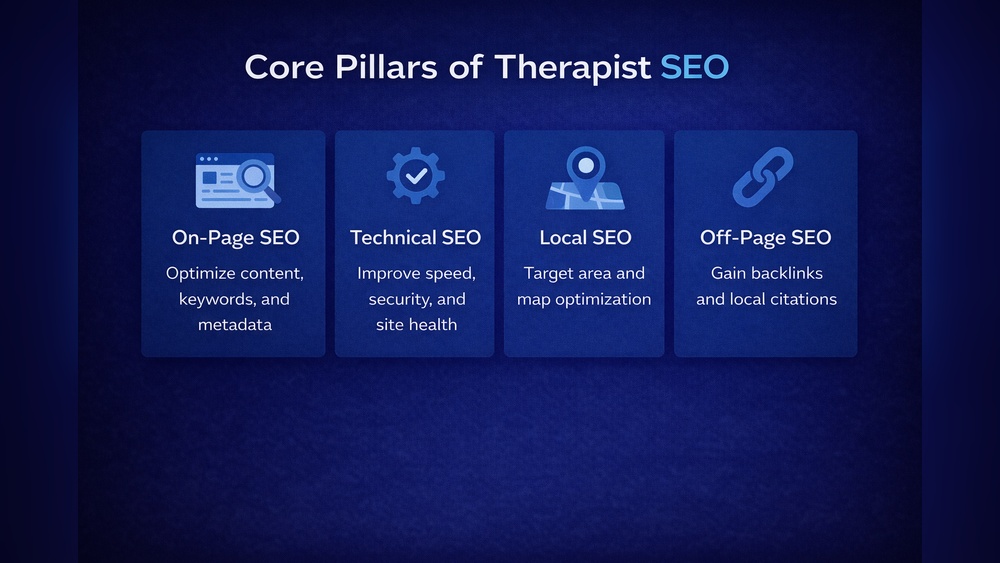
On-page SEO means making changes to your website to help search engines and users understand your content. Unlike off-page SEO (like getting links from other sites), on-page SEO is completely under your control. It includes things like your words, images, page structure, and even how fast your website loads.
For therapists, on-page SEO isn’t just about getting more visitors—it’s about attracting the right visitors. People seeking therapy often have sensitive needs, and they may search for specific services (like “anxiety counseling near me” or “child therapist in Chicago”). Good on-page SEO can help you connect with those searching for exactly what you offer.
On-page SEO also helps you stand out in a crowded space. Many therapists offer similar services, so being clear, specific, and optimized increases your chances of being noticed. When your website matches what people are searching for, Google is more likely to show your site higher in search results, and potential clients will feel more confident reaching out.
Common Mistakes Therapists Make With On-page Seo
- Using only technical jargon instead of words clients use.
- Having unclear page titles or missing meta descriptions.
- Ignoring image optimization or alt text.
- Forgetting local SEO elements like their city or neighborhood.
- Not updating content for years, which makes the site look outdated.
These errors can mean your site never shows up—even if you’re an excellent therapist.
Some beginners also make subtle mistakes, such as using the same keyword on every page (called “keyword cannibalization”). This confuses Google about which page is most important. Others may use images with no description, causing accessibility issues for users with disabilities and missing out on image search traffic.
Key On-page Seo Elements For Therapists
Let’s break down the most important parts of on-page SEO for therapy websites, with practical advice and real-world examples.
1. Choosing The Right Keywords
Keywords are the words or phrases people type into Google. For therapists, these might include:
- “Depression therapist in Boston”
- “Marriage counseling for couples”
- “Online therapy for teens”
Selecting the right keywords is essential because it connects your services with the people who need them. Using broad terms (“therapist”) may bring unqualified traffic, while specific phrases (“EMDR trauma therapist in Dallas”) attract those who are ready to book a session.
How To Find Good Keywords
- Use Google Search to see what suggestions appear as you type.
- Try tools like Google Keyword Planner or Ubersuggest.
- Ask clients what words they use when searching for help.
- Look at competitors’ websites to see which keywords they target.
- Check Google’s “People also ask” and “Related searches” sections for ideas.
Focusing on “long-tail” keywords (longer, more specific phrases) often brings better results, as there is less competition and the visitors are more likely to become clients.
Example
Instead of just “therapist,” use “anxiety therapist in Seattle” or “child counseling in Atlanta.” These are more likely to bring the right people.
Non-obvious insight: Many therapists ignore “symptom” keywords (like “panic attacks,” “overwhelmed by stress”), but people often search by symptoms, not just by service. Including these can bring in highly motivated clients.
2. Page Titles And Meta Descriptions
Every page on your site needs a clear title and a meta description. These appear in search results and help people decide to click.
Best Practices
- Include your main keyword and location if relevant.
- Keep titles under 60 characters.
- Write meta descriptions under 160 characters.
- Make them natural and inviting.
- Avoid repeating your business name in every title unless it adds value.
- Use action words (“Schedule,” “Get help,” “Start healing”).
Your titles and descriptions are like mini-ads—they should make people want to visit your site.
Example
Title: “anxiety Therapy In Austin | Compassionate Counseling For Adults”
Meta Description: “Get support for anxiety and stress from a licensed Austin therapist. Schedule your first session today.”
Non-obvious insight: If you offer teletherapy, mention this in your meta description (“Also serving clients statewide via online therapy”).
3. Headings (h1, H2, H3, Etc.)
Headings organize your content for both readers and search engines. They make your site easier to scan.
- H1: Main topic of the page (use your main keyword).
- H2: Main sections (like “Our Therapy Services”).
- H3: Sub-sections for extra detail.
Don’t use more than one H1 per page.
Example
H1: “child Therapy In Denver”
H2: “common Childhood Issues We Treat”
H3: “anxiety Disorders In Kids”
A well-structured heading system also helps people with screen readers navigate your site. It shows Google what your page is about, increasing your chances of ranking for specific topics.
4. Content Quality And Length
Google rewards pages with helpful, original content. For therapists, this means:
- Explaining your services in simple language.
- Answering common questions clients have.
- Describing your approach and philosophy.
- Providing examples (like case studies or FAQs).
Content should be specific. For example, instead of “I help with anxiety,” explain what anxiety looks like, how you work with clients, and what results to expect.
How Much Content?
Aim for at least 500-800 words on main pages. More detailed guides (like this one!) can go longer, but always focus on clarity and value.
- Home page: 600-1,000 words (overview of services, approach, credentials).
- Service pages: 500-900 words each (focus on who it’s for, how it helps, what to expect).
- About page: 400-600 words (tell your story, credentials, therapy style).
- Blog posts: 800-1,500+ words (answer specific questions, provide resources).
Break up long text with headings, bullet points, and images to make it easier to read.
Non-obvious insight: Google prefers content that “answers the question completely.” If you’re writing about anxiety therapy, cover causes, symptoms, your approach, and what happens in a session—not just a short overview.
5. Image Optimization
Images help people connect with your site emotionally, but they also need to be optimized for SEO.
- Use original photos if possible (your office, team, etc. ).
- Add alt text to each image describing what it shows, using keywords naturally.
- Compress images so they load fast (use tools like TinyPNG or JPEGmini).
- Use descriptive file names (“anxiety-therapy-office.jpg”) instead of random numbers.
Example Image Alt Text
- “Licensed therapist in Chicago office”
- “Family counseling session with parents and child”
Optimized images improve loading speed (which helps SEO), make your site accessible, and can even show up in Google Image Search.
Non-obvious insight: Adding your city or neighborhood to alt text (“Therapist office in downtown Seattle”) helps with local search.
6. Internal Linking
Internal links are links from one page on your site to another. They help visitors find useful information and keep them on your site longer.
Example
On your “Anxiety Therapy” page, link to your “About Me” page or “Contact” page.
“Learn more about my approach on the About page.”
You can also link from blog posts to your services. For example, in a post about coping with panic attacks, add: “If you’d like support with anxiety, learn more about my anxiety therapy services.”
Internal linking improves SEO and user experience. It also helps Google discover all your pages.
7. Mobile-friendliness
Most people now search on their phones. Google also ranks mobile-friendly sites higher.
How To Check
- Open your site on your phone—do the words and buttons look clear?
- Use Google’s Mobile-Friendly Test to check for problems.
- Make sure forms and clickable items are large enough to use with a finger.
A mobile-optimized site should load quickly, be easy to read, and not require zooming or sideways scrolling.
8. Fast Loading Speed
Slow sites frustrate visitors. Google also prefers sites that load quickly.
Tips To Improve Speed
- Compress images.
- Use a simple design (avoid heavy animations).
- Choose a good hosting provider.
- Limit plugins or add-ons that slow down your site.
- Enable browser caching if possible.
Loading speed matters for all users, but especially for those on mobile or with slower internet connections.
9. Url Structure
URLs should be short, clear, and include keywords.
Good Example
- Www.yoursite.com/anxiety-therapy-boston
Bad Example
- Www.yoursite.com/page?id=1234
Short, descriptive URLs are easier to share and remember. They also help search engines understand your page.
10. Schema Markup
Schema is special code that helps Google understand your business (like your address, hours, and reviews). For therapists, this can help your site show up in local searches with a map and business info.
Ask your web developer to add LocalBusiness schema or use a plugin if you’re on WordPress.
Schema can also display your ratings, price range, and even appointment links directly in search results, making your listing more attractive.
Non-obvious insight: Many therapists skip schema markup, but adding it can help you appear in “rich results” (like map packs), increasing visibility.
Structuring Your Therapist Website For Seo
How your site is organized matters as much as what’s on each page. Let’s look at an ideal structure for a therapy practice.
| Page Name | Purpose | SEO Opportunity |
|---|---|---|
| Home | Welcome, overview, main services, contact info | Main keywords, local info, easy navigation |
| About | Therapist background, philosophy, credentials | Expertise keywords, trust building |
| Services | List each type of therapy offered | Specific problem/solution keywords |
| FAQ | Answer common client questions | Long-tail keywords, voice search |
| Contact | Phone, email, address, map, form | Local SEO, “near me” searches |
| Blog/Resources | Helpful articles, tips, news | Regular updates, broad keyword coverage |
Tip: Don’t bury important pages (like “Book an Appointment”) under too many clicks. Make sure all main pages are easy to find from your homepage.
A clear structure also helps visitors feel comfortable and supported, especially if they’re already anxious about reaching out.
Writing Seo-friendly Content For Therapists
Understand Your Audience
Therapy clients are often nervous or uncertain. They want to know:
- Can you help with their specific issue?
- Are you experienced and trustworthy?
- Is your approach a good fit for them?
- How can they contact you?
Write in a clear, kind tone. Use simple words and avoid technical terms unless you explain them.
Example:
Instead of, “I use a psychodynamic, evidence-based approach to facilitate change,”
Try, “I help you understand your thoughts and feelings so you can make positive changes in your life. ”
Non-obvious insight: Address common worries directly. For example, “Many people feel nervous about starting therapy. That’s completely normal, and I’m here to make the process comfortable for you.”
Use Keywords Naturally
Don’t stuff keywords everywhere. Instead, include them where they make sense:
- In your page title and first paragraph.
- In headings and subheadings.
- In image alt text.
- In your meta description.
Example
Instead of:
“welcome To My Psychotherapy Site. I Help People.”
Try:
“As a licensed therapist in San Diego, I offer compassionate support for anxiety, depression, and relationship issues.”
Use synonyms and related words. For example, “stress management,” “worry,” and “panic attacks” all help Google understand your range of services.
Add Value With Original Content
Share insights from your experience. For example:
- Common myths about therapy.
- What a first session is really like.
- Tips for managing stress at home.
Non-obvious insight: Many therapists forget to talk about the “process”—what happens after someone reaches out. Explaining this can reduce anxiety and increase contact rates.
You can also add stories (anonymized) or examples to help people see themselves in your content.
Optimizing Main Pages For On-page Seo
Let’s look at how to optimize your key pages.
Home Page
- Use your main keyword (“Therapist in [City]”) in the H1 and first 100 words.
- List your main services with brief descriptions.
- Add a call to action (e.g., “Book a free consultation”).
- Show your photo for trust.
- Mention your credentials (e.g., “Licensed Clinical Social Worker”).
- Include location info (city, neighborhood).
- Link to your “About,” “Services,” and “Contact” pages.
Extra tips:
- Add a testimonial if possible.
- If you offer online therapy, state it clearly.
- Use bullet points for easy reading.
- If you offer services in multiple languages, mention them (e.g., “Therapy available in English and Spanish”).
About Page
- Share your story and why you became a therapist.
- Highlight special training or certifications.
- Use keywords like “licensed therapist,” “counseling experience,” and your city.
- Add a professional headshot.
- Mention your therapy style or approach.
Extra tips:
- Add a section like “How I Work” to explain what sessions are like.
- Include memberships in professional organizations.
- Mention your values (e.g., “I welcome clients of all backgrounds and identities”).
Services Pages
- Create a separate page for each main service (e.g., “Anxiety Therapy,” “Couples Counseling”).
- Explain who the service is for, common issues, and your approach.
- Use clear headings and bullet points.
- Add FAQs at the end.
Extra tips:
- Mention what clients can expect in the first session.
- List symptoms or situations you help with.
- Add a “Who This Is For” and “Who This Is Not For” section to filter for best-fit clients.
Contact Page
- List all ways to reach you: Phone, email, address.
- Include a contact form.
- Add a Google Map.
- Mention parking or public transit if relevant.
- Use keywords like “Contact [Your Name], therapist in [City].”
Extra tips:
- Add your office hours.
- Include a privacy statement for the contact form.
- Offer both phone and email options (some clients prefer not to call).
Blog/resources
- Write about topics your clients care about (e.g., “5 Ways to Reduce Stress,” “What to Expect in Family Therapy”).
- Use keywords naturally in titles and content.
- Link to your services where relevant.
- Update regularly (aim for at least one new article a month).
Extra tips:
- Answer seasonal questions (“Dealing with winter blues”).
- Summarize recent mental health research in plain language.
- Share local resources (support groups, hotlines).
Local On-page Seo For Therapists
Most therapy searches are local. “Therapist near me” or “counseling in [city]” are very common. Here’s how to boost your local SEO:
Use Location Keywords
Mention your city, neighborhood, or region throughout your site:
- In your page titles and meta descriptions.
- In headings.
- In your content (“I provide therapy for clients in Brooklyn, Queens, and Manhattan”).
Use variations: “counseling in [city],” “therapist near [landmark or area],” “online therapy for [state].”
Embed A Google Map
Add a map to your Contact page so clients know where you are.
List Your Address And Hours
Make sure your address and office hours appear the same way everywhere (website, Google, directories).
Non-obvious insight: Consistency in address format (Suite, Ste., #) helps with Google’s local trust.
Local Schema Markup
Add LocalBusiness schema to your site code so search engines know your location and services.
Extra tip: List nearby public transit stops or parking options to make in-person visits easier.
Image Optimization For Therapy Websites
Images are powerful for building trust. But you must optimize them for both speed and SEO.
Types Of Images To Use
- Your own professional photo.
- Photos of your office (warm, inviting spaces).
- Images showing diversity (if you serve all groups).
- Graphics or illustrations (e.g., mind-body diagrams, calming visuals).
Extra tip: Use “before and after” office photos if you’ve recently renovated, so clients know what to expect.
How To Optimize
- Use JPG or WebP format for photos, PNG for graphics.
- Keep file sizes under 200KB if possible.
- Use descriptive file names: “family-therapy-office.jpg” not “IMG_1234.jpg”.
- Add alt text that describes the image and includes a keyword if natural.
Non-obvious insight: Many therapists use only stock photos. Including even one real photo (your face, your office sign) increases trust and helps with local SEO.
Extra tip: Add captions under key images. Captions are read by both users and search engines.
Practical Example: Optimized Therapy Service Page
Let’s see what an optimized page for “Anxiety Therapy in Chicago” might look like.
Page Title: Anxiety Therapy in Chicago | Compassionate Support for Adults
Meta Description: Licensed Chicago therapist offering anxiety counseling in a safe, supportive environment. Start your healing journey today.
H1: Anxiety Therapy in Chicago
Content:
Do you feel overwhelmed by worry or stress? As a licensed therapist based in Chicago, I help adults and teens manage anxiety with proven counseling techniques. My office is located in Lakeview, close to public transit, making sessions easy to attend.
H2: How Anxiety Therapy Can Help
Anxiety can affect every part of your life—from sleep to relationships. In therapy, we’ll develop personalized tools for managing stress, including:
- Cognitive-behavioral strategies
- Relaxation techniques
- Mindfulness exercises
H2: What to Expect
Our first session is a chance to talk about your goals and concerns in a safe space. You’re not alone—many clients see improvement in just a few weeks.
H2: Schedule Your Session
Ready to get started? Contact me to book your first appointment. I offer both in-person and online sessions for Chicago residents.
Image:

Alt Text: “Chicago therapist office with comfortable seating and calming decor”
Extra tips:
- Add a short testimonial: “I felt welcomed and supported from my first session.” — C.M., Chicago
- Include a FAQ section at the bottom: “Is therapy confidential? What are your fees?”
Advanced On-page Seo Strategies For Therapists
1. Faq Sections
Adding a FAQ (Frequently Asked Questions) section to key pages helps you capture voice search and long-tail keywords. It also reassures visitors.
Example Faqs
- How do I know if therapy is right for me?
- What does a first session look like?
- Is everything confidential?
- Do you accept insurance?
- How many sessions will I need?
Non-obvious insight: Use real client questions you hear during consultations. This keeps your FAQs relevant and personal.
2. Blog Content Targeting Specific Issues
Write blog posts answering questions or concerns your clients have, such as:
- “Signs of social anxiety in teenagers”
- “How to choose the right couples therapist”
- “Tips for managing panic attacks at home”
This builds trust, shows your expertise, and helps your site rank for more keywords.
Extra tip: Add “related posts” at the end of each blog post to keep visitors on your site.
3. Use Of Video And Audio
Short videos (even 1-2 minutes) introducing yourself or explaining your approach can keep visitors engaged. Add transcripts for accessibility and SEO.
Examples:
- “Meet Your Therapist: [Your Name]”
- “What Happens in a Therapy Session?”
- “Guided Mindfulness Exercise for Anxiety”
Audio files (like a short meditation) can also engage visitors. Always provide transcripts for accessibility.
4. Accessibility
Ensure your site is usable by everyone, including those with disabilities:
- Use readable font sizes.
- Ensure good color contrast.
- Add alt text for all images.
- Make sure all buttons/links are easy to tap on mobile.
- Avoid using only color to show meaning (e.g., don’t use red text alone for errors).
Extra tip: Test your site with a screen reader or accessibility tool.
5. Testimonials And Reviews
Show reviews from real clients (with permission) or link to third-party review sites. Use schema markup for reviews if possible.
Extra tips:
- Add initials and city for authenticity (“—J.S., Seattle”).
- Use a mix of written and video testimonials if possible.
- Display badges from professional organizations (“Member, American Counseling Association”).
Measuring Your On-page Seo Success
How do you know if your SEO is working? Track these metrics:
1. Google Search Console
Shows which keywords bring people to your site, what pages they visit, and if Google finds any errors.
- Check for “Coverage” issues—fix or redirect broken pages.
- Look at “Performance” to see which queries and pages get clicks.
2. Google Analytics
See how many people visit your site, how long they stay, and which pages they read.
- Monitor “bounce rate” (percent leaving after one page)—lower is better.
- Track “conversions” (form submissions, calls).
3. Ranking Tools
Use a tool like Moz, Ahrefs, or SEMrush to track your keyword rankings over time.
- Watch how your pages rise or fall for target keywords.
- Set alerts for big changes.
4. Contact Form Submissions
Are you getting more inquiries since improving your SEO? This is the ultimate goal.
Non-obvious insight: Sometimes traffic grows but calls do not—check that your contact form is working and easy to find.
Visual Guide: Example Therapy Website Structure
Here’s a simple diagram showing how pages on a therapy website can link together for the best SEO:

*Alt text: “Diagram showing Home page linking to About, Services, Blog, and Contact pages.”*
A good structure also means important pages are no more than two clicks from the homepage.
Comparing On-page Seo Elements For Therapists
To see how different on-page elements affect SEO, here’s a comparison:
| Element | Poor Practice | Best Practice | Impact |
|---|---|---|---|
| Page Title | “Welcome” | “Anxiety Therapy in Miami” | Better ranking for target clients |
| Image Alt Text | “photo1” | “Therapist talking with client” | Accessibility, image search ranking |
| Internal Links | None | Links to related services | Longer site visits, better navigation |
| Content Length | 100 words | 600+ words, detailed | Greater authority, better ranking |
| Local Info | Missing | City and neighborhood mentioned | Shows up for local searches |
The Role Of Trust And Authority In Therapist Seo
Trust is essential in therapy—and in SEO. Google wants to show sites that are real, credible, and safe. Here’s how to build trust on your site:
- List your credentials and licenses.
- Use real photos, not only stock images.
- Get listed on professional directories (like Psychology Today).
- Keep your site updated (add new blog posts, update your hours or fees).
- Use HTTPS (secure website) for privacy.
Non-obvious insight: Adding links to respected organizations (like the American Psychological Association) can boost your credibility with both users and search engines.
Extra tip: Display your license number and state/country. In some places, this is required by law.
Real-world Case Study: Improved Seo For A Therapist
Dr. Laura Smith, a family therapist in Seattle, was struggling to get new clients online. Her old website had little content, no location info, and used generic titles like “Home” and “Contact. ”
What Changed:
- She rewrote her Home page to say “Family Therapy in Seattle – Dr. Laura Smith.”
- Added detailed service pages for “Teen Counseling,” “Marriage Therapy,” and “Grief Support.”
- Used real photos of her office and herself.
- Added a FAQ and a Google Map.
- Wrote blog posts on “How to Talk to Your Teen About Stress” and “Coping with Grief During Holidays.”
Results:
Within four months, her website appeared in the top three Google results for “family therapist Seattle. ” She saw a 40% increase in contact form submissions and more calls from her local area.
Non-obvious insight: She updated her FAQ monthly, adding new questions she heard from clients. This kept her site fresh and relevant.
How To Keep Your On-page Seo Up To Date
SEO is not a one-time task. Search trends, Google’s algorithms, and client needs change over time. Here’s how to stay current:
1. Review Your Site Quarterly
Read through your main pages and update any outdated info (like office hours, insurance details, or new services).
2. Add Fresh Content Regularly
A new blog post every month shows your site is active. Write about seasonal topics (like “Managing holiday stress”) or respond to common questions.
3. Check Your Analytics
Look for pages with high bounce rates (people leave quickly) or low traffic. Update these pages with clearer content or better keywords.
4. Test Your Site On Mobile
After any changes, open your site on your phone and check that everything looks right.
5. Update Your Images
Switch out old photos for new ones every year, or add new staff/team images if you grow.
Extra tip: Set a calendar reminder to review your site every three months.
Common On-page Seo Mistakes Therapists Should Avoid
- Ignoring local keywords: Not mentioning your city or neighborhood reduces local search visibility.
- Using too much jargon: Clients may not know clinical terms; use simple language.
- Forgetting mobile users: Many will visit your site on their phone.
- Not updating content: Outdated info looks unprofessional.
- Missing contact info: Make it easy to call or email you.
- Neglecting image alt text: Hurts accessibility and SEO.
- Thin content: Pages with under 100 words rarely rank well.
- Unclear service pages: Each service should have its own page.
- No internal links: Missed opportunity to guide users.
- No call to action: Always tell visitors what to do next.
Non-obvious insight: Don’t duplicate content across pages (copy-paste). Google may ignore or penalize duplicate text.
Useful Tools And Resources For Therapist Seo
- Google Search Console: See how your site appears in search and fix errors.
- Google Keyword Planner: Find keywords clients use.
- Yoast SEO Plugin (WordPress): Helps you optimize pages and posts.
- TinyPNG or JPEGmini: Compress images for faster loading.
- Mobile-Friendly Test: Test your site’s mobile usability.
- MozBar: Check on-page SEO elements in your browser.
- Answer the Public: Generates common questions people search for.
- Canva: Create simple graphics or infographics for your blog.
- Grammarly: Check for spelling and grammar mistakes.
For deeper reading, check Search Engine Journal’s On-Page SEO Guide.
How Images Can Boost Trust And Seo For Therapists
Therapy is deeply personal. Photos help clients feel comfortable before their first session. Here’s how to use images well:
- Show your face: People want to know who they’ll be meeting.
- Office environment: A welcoming waiting area or therapy room can reduce anxiety.
- Diversity: Reflect your client base if possible.
- Add captions: Briefly describe the photo for extra clarity.
- Use images for blog posts: For example, a calming nature photo for a post about stress reduction.
Image example:

*Alt text: “Therapist welcoming client at office door in New York City”*
Non-obvious insight: If you serve kids or families, include images of toys, games, or family-friendly spaces.
Sample Blog Post Ideas For Therapy Seo
- “How to Prepare for Your First Therapy Session”
- “Understanding the Signs of Depression”
- “Benefits of Online Counseling for Busy Professionals”
- “When Should Couples Seek Therapy?”
- “Tips for Parents of Anxious Children”
- “What is Cognitive Behavioral Therapy (CBT)?”
- “How to Cope with Social Anxiety in Public Places”
- “Ways to Support a Friend with Depression”
- “The Role of Self-Care in Mental Health”
- “Dealing with Workplace Stress and Burnout”
Each post should answer real questions, use keywords naturally, and link to your service pages.
Extra tip: End each post with a call to action (e.g., “If you’d like support, contact me for an appointment”).
Table: Example Keywords For Therapists By Specialty
| Specialty | Example Keywords |
|---|---|
| Anxiety Therapy | anxiety therapist in [city], anxiety counseling, help for anxiety |
| Couples Counseling | marriage counseling [city], couples therapy near me, relationship therapist |
| Child Therapy | child therapist, play therapy [city], child counseling services |
| Online Therapy | online therapist, teletherapy, virtual counseling |
| Trauma Therapy | trauma therapist, PTSD counseling, trauma recovery [city] |
Extra tip: Research what terms are most common in your area (“psychotherapist” vs. “counselor” vs. “therapist”).
Getting The Most From On-page Seo As A Therapist
On-page SEO is about more than ticking boxes—it’s about showing potential clients who you are, what you offer, and how you can help. Remember:
- Use clear language and structure.
- Focus on what clients care about.
- Keep your site fresh and up to date.
- Check your analytics and improve over time.
- Make it easy for clients to contact you or book a session.
- Show your expertise and care through every page.
With these steps, you’ll be easier to find and more welcoming to those who need your help.
Frequently Asked Questions
What Is The Most Important On-page Seo Factor For Therapists?
The most important factor is matching your page titles, headings, and content to what your clients are searching for. Use clear keywords like “therapist in [city]” and make sure every page explains your services in simple terms.
How Often Should I Update My Therapy Website For Seo?
Aim to review your main pages every 3-6 months. Update service details, add new blog posts, and refresh images regularly. Google prefers sites that are active and current.
Do I Need A Blog For Good Seo As A Therapist?
Having a blog helps you rank for more keywords and answer client questions. Even one post per month can make a big difference in your visibility and trust.
Should I Use My Real Photos Or Stock Images?
Real photos (your face, your office) build more trust and help with local SEO. You can use some stock images, but always include at least a few original photos.
What If I’m Not Tech-savvy? Can I Do On-page Seo Myself?
Many SEO basics—like writing clear page titles, updating content, and adding images—can be done without coding. For advanced things (like schema markup), you may want help from a web designer or SEO expert.
By following these steps, you’ll give your therapy practice the best chance to be found by clients who need your care. On-page SEO isn’t a mystery—it’s a set of clear, practical actions that help both your practice and the people you serve.
Keep Reading
Want this done for you? See website design and development or request a free local SEO audit.